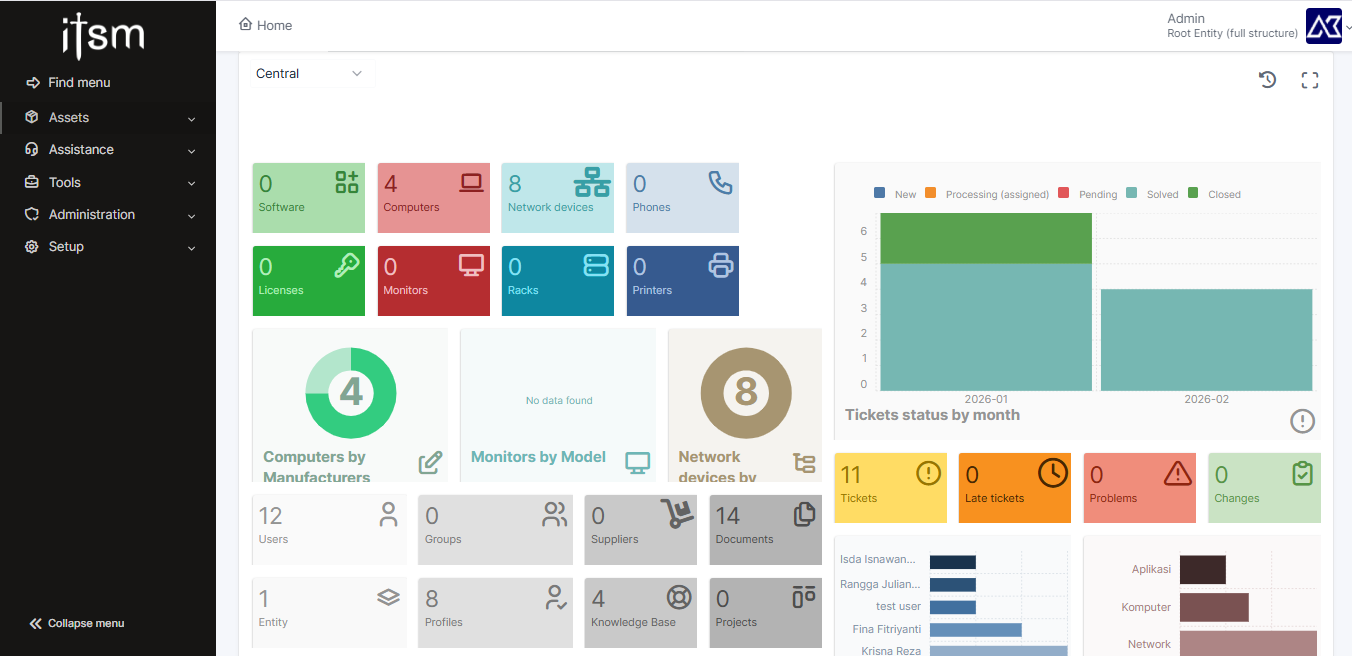
Main Features and Functions:
Asset Management:
Tracks hardware inventory such as computers, servers, printers, monitors, network devices, and software licenses.
Ticketing System (Service Desk):
Provides a portal for reporting incidents or requesting IT services, making it easier for technical teams to handle user issues in an organized manner.
Reporting and Statistics:
Generates detailed reports on asset usage and support team performance to support better decision-making.
Technologies:
1. Programming Language & Backend
PHP – The latest versions typically require PHP 8.1 or higher for optimal performance.
PHP Extensions – Requires various modules such as mysqli (for database), gd (graphics), curl, mbstring, and json.
2. Database Management (MySQL / MariaDB):
Used as the primary data storage. The ITSM system stores all inventory, ticketing, and user configuration data in a relational database format.
3. Web Server
Can run on most web servers that support PHP, including:
- Apache (most commonly used)
- Nginx (often used for high performance)
- Microsoft IIS or lighttpd
4. Architecture & Automated Inventory (LAMP/LEMP Stack):
A combination of Linux, Apache/Nginx, MySQL/MariaDB, and PHP forms the core foundation of this application.
5. Security & Integration
LDAP / Active Directory:
Supports directory protocol technologies to synchronize user accounts from Windows servers or other external systems.
REST API:
Allows developers to integrate the system with third-party applications through JSON-based data exchange.